Affordable restaurant website design starts with the questions guests ask before they visit: what is on the menu, which location they need, when it is open, and how to order, book, or get in touch. For a café or ice cream shop, those answers may matter more at launch than a complex customer account system.
This guide explains how to scope a hospitality website without treating every optional feature as a day-one requirement. Our Lighthouse Ice Cream & Treats project provides a concrete example of two locations, different menus, events, and private party inquiries.
Define the essential visit before requesting a quote
Write down the route a customer should follow. A first-time visitor might arrive on a location page, read the menu, check the address, and use the directions link. Someone planning a gathering needs party information and a different contact action.
A practical first-phase brief usually includes the business introduction, menu information, actual location details, useful photos, and the actions guests need. If you use an existing ordering or reservation provider, ask whether a link is enough or whether you need a deeper integration. These are different scopes.
Choose a menu format your team can maintain
Menu content can be presented directly on the page, as a document, or through a connected tool. Ask to see how the result works on a phone and how your staff will change an item or price. The choice affects both the build and the ongoing work.
For a custom website, page-based menu sections can make categories and descriptions easier to navigate. A document can still be available as a download. If frequent changes are important, include the editing workflow in the proposal rather than assuming that every custom site has a staff dashboard.
- Which menus are different: lunch, dinner, drinks, or location-specific offers?
- Who supplies final names, descriptions, prices, and approved photos?
- Who makes changes after launch, and how are they billed?
- Who verifies dietary or allergen information before publishing?
- How will guests reach the current menu from each location page?
A real example: two Lighthouse shops
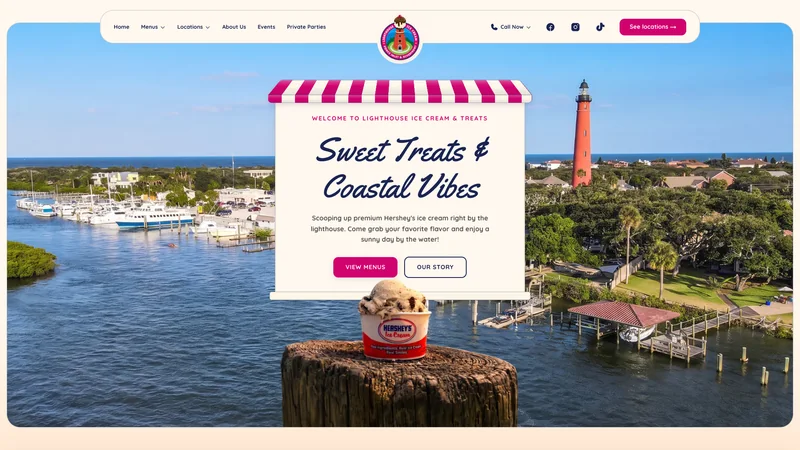
The Lighthouse site gives Ponce Inlet and Riverfront their own location pages. Each has an introduction, shop photography, visiting details, and its own menu. The homepage introduces both shops, while location navigation helps people reach the right page.
Events and private party inquiries have separate pages because they answer different questions from the everyday menu. That is a page-structure example, not a claim that the website produced a particular increase in traffic, reservations, or sales.
What changes the cost of a restaurant website?
| Requirement | What to clarify |
|---|---|
| Multiple locations | Which menus, hours, contact details, and photos differ? |
| Menu updates | Does staff need editing access, or will updates be requested? |
| Ordering and bookings | Is this an external link, an integration, or a new custom workflow? |
| Events and parties | Do you need information, an inquiry form, ticket links, or a booking system? |
| Content and photography | What is already approved, and what must be created? |
At Zay Web Solutions, website work is $100 per hour, with hosting at $500 per year, billed annually and separately. We estimate the agreed scope before starting. A hypothetical 20-hour project would be $2,000 in website work, plus $500 for one year of hosting. That $2,500 example is not a restaurant website package or an estimate for your business; subscriptions, domains, applicable taxes, and other agreed costs are separate.
Keep local information accurate
Put the correct address, hours, phone number, and menu link with the relevant shop. Seasonal hours and location-specific offers need a clear owner for updates. A location page should help someone visit a real business location, rather than simply repeat a city name.
If the business uses Google Business Profile, review its information alongside the website. Google's business representation guidelines describe eligibility and accurate location details. Its local ranking guidance explains that local results depend on several factors, so a website or profile change is not a guarantee of a particular position.
Send a restaurant website brief that can be priced
Include your locations, current menus, desired ordering or booking tools, approved photos, and who will maintain the content. Mark optional features separately. Ask the developer to distinguish launch work from hosting, ongoing edits, and any separate SEO service.
Explore the Lighthouse hospitality project, compare budget-first website scope decisions, or tell us about your restaurant, café, or shop.